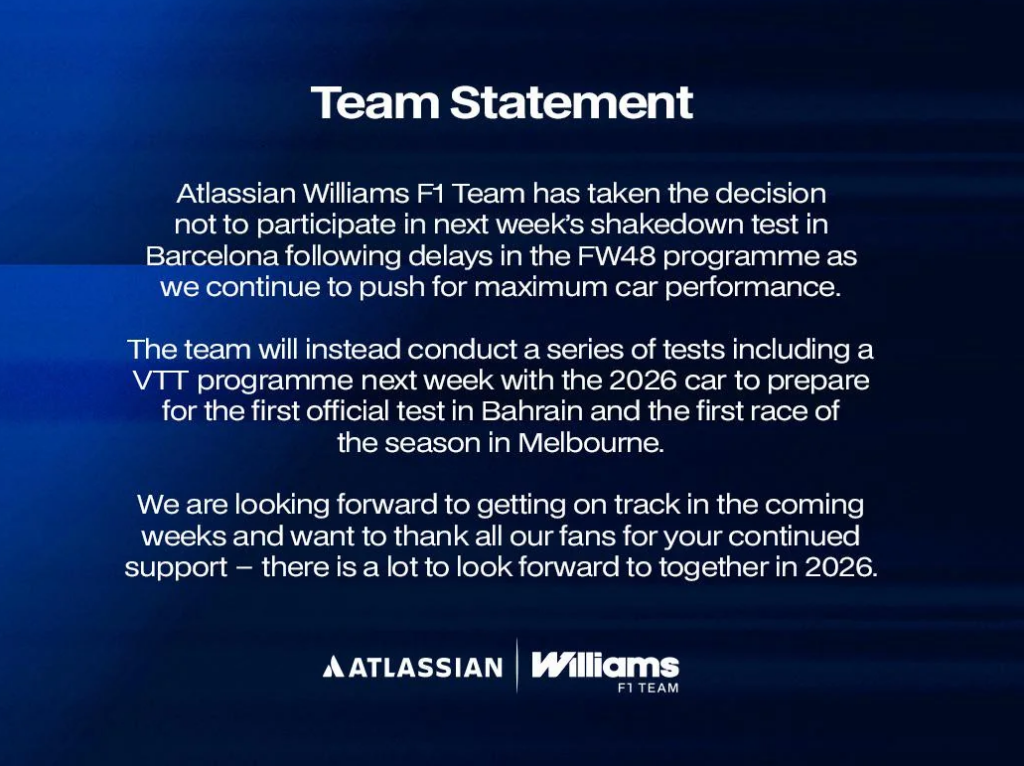
Williams has officially confirmed it will miss the opening pre-season test in Barcelona, losing five critical days of track time as teams prepare for the biggest regulation change in Formula 1 history. The team cited “delays in the FW48 programme as we continue to push for maximum car performance,” but the reality runs deeper than a simple scheduling issue.
Sources have confirmed that Williams struggled recently to pass FIA-mandated crash tests. While they corrected the issues, manufacturing replacement parts couldn’t happen fast enough to meet the Barcelona deadline. This setback will seriously hamper their efforts at the start of the season, preventing them from collecting crucial data on tire wear, fuel burn, heat dissipation, brake wear, battery performance, and systems integration.
Why 2026 Makes This Critical
The timing couldn’t be worse. The 2026 season introduces new chassis and power units in what many describe as the biggest regulation change in the sport’s history. The power balance has shifted dramatically, with the internal combustion engine output cut while the electric motor has tripled, creating a roughly 50-50 split between gasoline and electric power. Add a massive 30kg weight reduction, and you have a completely different beast to understand.
Nothing beats pounding out laps on a track the team knows well. Barcelona allows teams to see how actual on-track running correlates with what their CFD, wind tunnel, and simulation models predict. Not running prevents this and delays their ability to understand how everything will work during a race weekend. With drivers Alex Albon and Carlos Sainz now limited to three days each across the two Bahrain tests, the margin for error has shrunk considerably.
A Different Kind of Setback
Here’s what separates this situation from the 2019 disaster when Williams also missed testing. Back then, under Paddy Lowe’s leadership, the team missed tests because their systems and practices broke down. They didn’t have a car assembled because fundamental processes failed, exposing weaknesses that James Vowles has spent years fixing.
This time, the failed tests indicate Williams was pushing limits and exceeded them. That shows the team is aggressive and confident. A few years ago, their car was overweight, meaning it would be slower regardless of other parameters. Now they’re testing boundaries, which signals a long-overdue cultural change yielding results.
What to Expect Early Season
American fans should prepare for a rough start. The team will likely struggle and potentially experience reliability issues through the first few races. Their focus will be on getting the car running well, possibly opting for more conservative approaches to qualifying and race strategy to maximize running time. Expect struggles until after Miami.
By then, Williams will have several races worth of data to assess whether updates are needed or if they’re already too far behind competitors like Aston Martin and Racing Bulls. Both teams have new engine partners and will need time to get their chassis and engine combinations working, making them realistic benchmarks for Williams as “best of the rest.”
The Mitigation Strategy
Williams isn’t panicking. They’ll conduct private testing ahead of Bahrain, including a Virtual Track Testing program with their 2026 car. The team is still scheduled to officially launch the FW48 on February 3 before the second Bahrain test. That level-headedness and competence in the face of setbacks shows the leadership has accounted for this possibility.
If Williams gets to mid-season and shows improvement, the time lost in Barcelona will be mitigated. When the team brings upgrades and those upgrades work, they’ll know they have good correlation between the track and their development tools. That’s when you’ll see the team take more risks with setups, qualifying, and racing because they believe in their direction.
This is a setback, not a catastrophe. Williams now has the pieces in place to overcome adversity. If they can consistently perform, improve, and bounce back, they’ll demonstrate they’re getting back to the front and will soon be a threat to the leading teams.