I’ve watched Formula 1 long enough to know when a personnel announcement carries weight beyond the press release.
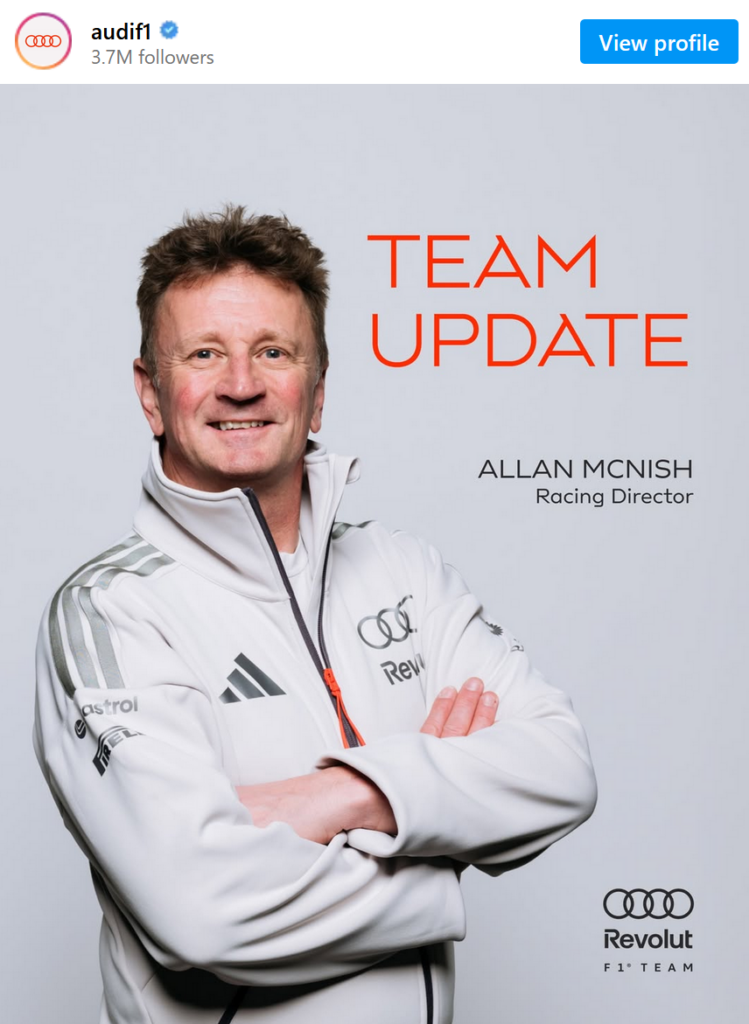
Allan McNish stepping into the race director role at Audi F1 is one of those moments.
The timing tells you everything. Audi’s debut 2026 season started with Jonathan Wheatley’s unexpected departure as Team Principal just two races in. Mattia Binotto took on dual responsibilities as CEO and Team Principal, but he made it clear he wouldn’t attend every race weekend. He prioritized the factory-based transformation at Hinwil and the engine facility in Neuburg.
That left a gap. A critical one.
McNish fills it starting from the Miami Grand Prix onwards. But this appointment represents more than filling a vacancy. It signals something deeper about how Audi approaches building a championship-caliber F1 operation.
The Leadership Turbulence Nobody Talks About
Let me be direct about what happened here.
Audi entered F1 with ambitious goals. The stated target is competing for world championships by 2030. That’s a four-year runway from their 2026 entry to championship contention. The timeline is aggressive. The investment is substantial, backed by both the manufacturer and the Qatar Investment Authority, which purchased a significant minority stake in November 2024.
But leadership instability can derail even the best-funded projects.
Wheatley’s departure created uncertainty at exactly the wrong time. New teams need stability during their formative seasons. They need leaders who understand the operational rhythm of race weekends, who can make split-second strategic calls, who can connect the factory’s technical development with trackside execution.
McNish brings all of that. And he brings it from inside the existing structure.
This is Audi’s first senior appointment from within rather than an external hire.
That matters because institutional knowledge during pivotal moments prevents the kind of disconnects that plague new teams. McNish has been entrenched in Audi’s motorsport structure since he finished his racing career with the manufacturer in 2013. He served as Director of Coordination for Audi Group Motorsport. He was Team Principal of Audi Sport ABT Schaeffler in Formula E, where he won the Team Championship in his first year in the role.
He’s been involved with Audi’s F1 project since its inception.
What a Race Director Actually Does
The title sounds straightforward. The reality is anything but.
McNish’s responsibilities include oversight of sporting matters, engineering coordination, driver management, race strategy, and garage operations. He also handles on-track media and partner activities. Binotto emphasized that “Allan’s ability to connect all performance-related areas – from sporting operations to driver development – will be fundamental as we continue to build our team.”
Let me break down what that means in practice.
During a race weekend, strategy teams process thousands of data samples every second from both their own cars and competitors. They analyze tire degradation curves, pit stop loss, weather predictions, overtaking probability, and scenario planning for safety cars and unexpected competitor moves.
The race director synthesizes all of this. They make the final call.
And they do it under pressure that most people can’t comprehend. One wrong strategic decision can cost you a podium. Or points. Or a championship position that affects your budget cap allocation for the following season.
McNish’s experience as both a championship-winning driver and team principal positions him uniquely to make these calls.
He’s a three-time Le Mans 24 Hours winner (1998, 2008, 2013). He’s the 2013 FIA World Endurance Champion. He won the American Le Mans Series championship with Audi teammate Dindo Capello in 2006 and 2007. He captured four overall victories at the 12 Hours of Sebring.
That’s the driver side.
On the management side, he demonstrated at Formula E that he can lead teams to victory from the pit wall. His technical understanding connects with operational execution in a way that pure administrators can’t replicate.
The F1 Background You Probably Didn’t Know About
Here’s where it gets interesting.
Most people associate McNish exclusively with endurance racing. That makes sense given his Le Mans success. But his F1 background adds relevant context that often gets overlooked.
McNish made 17 starts with Toyota F1 in 2002. He held test or development roles with McLaren, Benetton, and Renault. He was nearly called up to replace an unwell Gerhard Berger at the 1991 Monaco GP while serving as McLaren’s test driver.
His F1 experience, though limited in race starts, provides understanding of the sport’s operational demands and political landscape.
And that political landscape is brutal.
F1 operates at the intersection of engineering excellence, commercial interests, regulatory gamesmanship, and media scrutiny. You need someone who understands all of those dimensions. Someone who can navigate the FIA’s sporting regulations while managing driver egos while coordinating with the technical team while handling sponsor obligations.
McNish has seen it from multiple angles. Driver. Test driver. Team principal. Development program director.
That breadth of experience is rare.
Why Internal Promotions Signal Organizational Maturity
I want to focus on something that might seem minor but actually reveals a lot about Audi’s approach.
McNish represents continuity in a sport obsessed with poaching talent.
F1 teams constantly raid each other for personnel. Technical directors jump between teams. Engineers follow salaries. Even team principals switch allegiances. It’s part of the sport’s DNA.
Audi could have gone external. They could have thrown money at an established race director from another team. They could have made a splashy hire that generated headlines.
They didn’t.
They promoted from within. They rewarded someone who has been building this project alongside them. Someone who describes Audi as “a marque that means a lot to me.” Someone whose loyalty runs both ways.
That decision reflects organizational maturity.
It shows Audi understands that championship success comes from cohesive teams, not collections of individual stars. It demonstrates they value institutional knowledge and cultural fit alongside credentials and experience.
And it sends a message to everyone else in the organization: we develop our people, we promote from within, we reward commitment.
The 2030 Championship Vision
Let’s talk about what McNish is actually walking into.
Audi’s goal is competing for world championships by 2030. That’s four years from their 2026 entry. Four years to go from new team to championship contender.
The timeline is ambitious. Some would say unrealistic.
But McNish’s role focuses on ensuring “all aspects of our race operations are delivering at their most competitive level and continuously improving.” That’s the foundation. You don’t build championship operations overnight. You build them through relentless incremental improvement across every operational dimension.
Race strategy. Pit stop execution. Tire management. Driver coaching. Engineering feedback loops. Data analysis. Competitor monitoring.
All of it has to work. All of it has to improve. All of it has to integrate seamlessly.
McNish maintains his existing role as Director of the Audi Driver Development Programme while taking on the race director responsibilities. That dual role creates alignment between driver development and race operations. The drivers coming through the program will be shaped by someone who also runs race weekends. That integration matters.
It prevents the disconnect you see at some teams where driver development operates in a silo separate from race operations.
What This Means for Audi’s Competitive Timeline
I’m going to be honest about the challenges ahead.
New F1 teams struggle. History shows us this repeatedly. The last truly successful new team entry was probably Brawn GP in 2009, and they were essentially a rebranded Honda with carryover infrastructure and personnel.
Building from scratch is different.
Audi has advantages. They have manufacturer backing. They have serious financial resources. They have motorsport heritage and engineering expertise from other racing series.
But F1 is different from endurance racing. The development pace is faster. The competitive margins are smaller. The regulatory complexity is higher. The political dynamics are more intense.
McNish’s appointment strengthens trackside leadership at what Binotto describes as “a crucial stage of our project.” That’s accurate. The first few seasons define a team’s trajectory. They establish operational patterns. They build team culture. They determine whether the organization can learn and adapt quickly enough to close the gap to established competitors.
McNish gives Audi a better chance of navigating that crucial stage successfully.
Not because he’s a magic solution. But because he brings proven championship-caliber leadership, deep Audi heritage, comprehensive technical understanding, and the operational experience to connect factory development with trackside execution.
The Broader Pattern in F1 Leadership
Let me zoom out for a moment.
F1 is experiencing a shift in how teams approach leadership structures. The traditional model centered everything around the team principal. One person held ultimate authority over technical, sporting, and commercial decisions.
That model is evolving.
Teams are distributing responsibilities. They’re creating specialized leadership roles. They’re separating trackside operations from factory-based development. They’re recognizing that modern F1 teams are too complex for single-point leadership.
Audi’s structure reflects this evolution. Binotto handles CEO and Team Principal responsibilities but focuses on factory transformation. McNish handles trackside operations and race direction. The roles complement each other rather than overlap.
This distributed leadership model only works when you have the right people in the right roles.
McNish fits the race director role. His background aligns with the requirements. His experience matches the demands. His relationship with Audi provides the trust and alignment needed for distributed leadership to function.
What I’m Watching For
McNish takes over trackside accountability from Miami onwards. That gives us a clear timeline for evaluation.
Here’s what I’ll be watching:
Strategic decision-making under pressure. How does the team handle mixed conditions? Do they make aggressive or conservative strategy calls? Do they react quickly to safety cars and incidents?
Driver development and management. How do the drivers respond to McNish’s coaching? Does their racecraft improve? Do they make fewer mistakes?
Operational execution. Pit stops. Tire management. Qualifying preparation. Race starts. All the details that separate good teams from great ones.
Team cohesion. Does the trackside operation integrate smoothly with factory development? Do you see alignment between what the engineers design and what the race team can execute?
Continuous improvement. Does the team learn from mistakes? Do they close the gap to competitors? Do they show progress across the season?
These metrics matter more than raw results in the first few seasons. New teams need to demonstrate they can learn, adapt, and improve. That’s what predicts long-term success.
The Bottom Line
Allan McNish’s appointment as Audi F1 race director is the kind of move that looks straightforward on the surface but carries significant strategic weight underneath.
It addresses immediate operational needs following Wheatley’s departure. It provides trackside leadership stability during a crucial development phase. It leverages internal talent with deep institutional knowledge. It aligns driver development with race operations. It reflects organizational maturity in how Audi approaches team building.
Most importantly, it gives Audi a legitimate shot at their 2030 championship vision.
Not a guarantee. A shot.
McNish brings championship-caliber leadership, proven operational expertise, comprehensive technical understanding, and the kind of Audi heritage that creates alignment between individual ambition and organizational goals.
That’s what you need when you’re trying to build a championship-contending F1 team in four years.
The timeline is aggressive. The challenges are substantial. The competition is fierce.
But Audi just strengthened their chances of pulling it off.
Now we watch to see if McNish can translate his endurance racing success and Formula E championship into F1 operational excellence. Starting from Miami, we’ll get our answer one race weekend at a time.