I was disappointed before I was excited.
When Formula 1 announced its return to America after nine years away, my first reaction wasn’t pure joy. It was frustration. Indianapolis Motor Speedway? Really? After nearly a decade of waiting for F1 to come back to American soil, they were going to put those magnificent machines on a flat, modified oval instead of a proper road course.
I wanted Spa’s elevation changes. I wanted Suzuka’s flowing corners, I wanted Imola’s countryside scenery. Instead, fans got a compromise track that seemed to miss the point of what makes F1 cars special.
But sometimes the wrong choice teaches you everything about what’s right.
The Wreckage of American Open-Wheel Racing
The timing of F1’s return couldn’t have been more symbolic. American open-wheel racing was tearing itself apart.
The CART/IRL split had been devastating our domestic series since 1996. What was once the most popular auto racing series in the country had become a destructive civil war, splitting sponsors and teams while NASCAR scooped up disenfranchised fans.
And here was Tony George, the man whose family owned Indianapolis Motor Speedway and whose formation of the IRL had helped fracture everything we loved about American open-wheel racing, now hosting Formula 1.
I felt uneasy walking through those gates. My love of F1 overcame that uneasiness, but the conflict was real.
The View From the South Grandstands
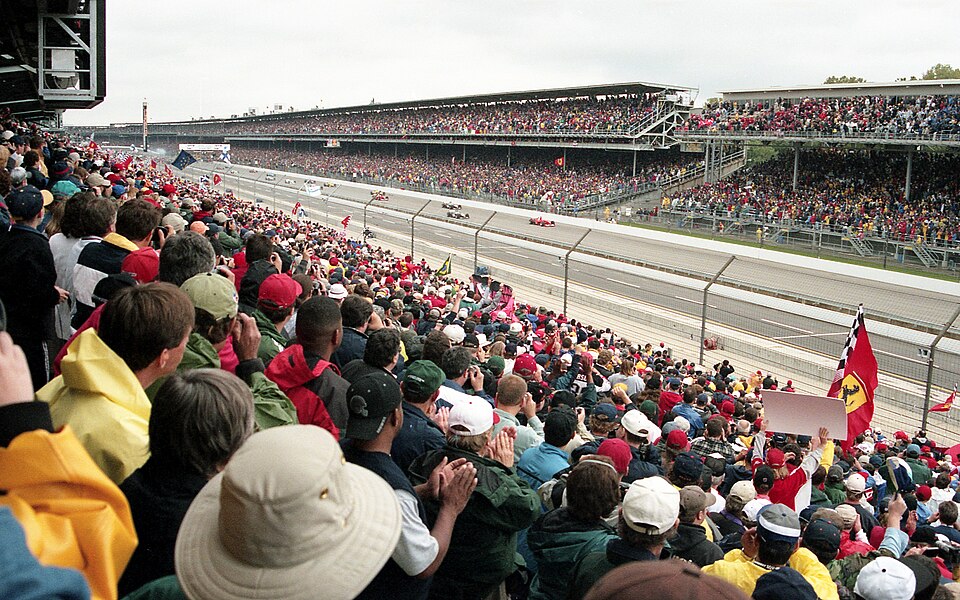
I sat in the south grandstands just past Turn 13, watching those cars transition from the tight infield section onto the banked oval. The transition wasn’t elegant. The infield was too flat, too constrained for cars that belonged on undulating terrain.
But something unexpected happened from that vantage point.
I could see almost the entire track. When those cars came down the main straight, you could witness their speed, nimbleness, and associated noise in a way that traditional F1 circuits never allow. The 250,000 spectators around me were seeing something they’d never seen before.
In that moment, I realized F1 wasn’t trying to replace American racing. It was offering refuge from our civil war.
The Wisdom of Imperfect Stepping Stones
Michael Schumacher won that day, strengthening his championship run on American soil. But the real victory was subtler.
Indianapolis gave F1 something no purpose-built facility could provide: authenticity rooted in American racing heritage. Yes, the track compromised what F1 cars could do. But it didn’t compromise F1’s ability to connect with American audiences.
The track was a stepping stone, a period of transition where F1 was finally finding its way back to prominence in America. The compromise was necessary to enable better tracks like Circuit of the Americas to host F1 in the future.
When I watch today’s American F1 explosion with Miami, Las Vegas, and Austin, I don’t feel the same emotions I felt in 2000. That day at Indianapolis was pure relief that F1 was back in the states and I could watch it in person again.
Authenticity vs. Spectacle
F1 has become more open and accessible since that September day in 2000. But there’s a danger of it becoming too much show and less about racing.
That’s the balancing act all racing series contend with. Indianapolis had authenticity despite not being as flashy as Las Vegas. The Speedway has a rich tradition of auto racing and knows how to put on a great event for fans without losing the essence of what makes racing compelling.
The lesson from that imperfect but authentic Indianapolis experience was more important than any of us realized at the time.
Don’t think of compromises as the end state. Think of them as steps along the way toward something better.
That flat, modified oval taught F1 how to truly connect with American audiences instead of just trying to dazzle them. It showed that authenticity matters more than perfection, that heritage can bridge cultural gaps in ways that purpose-built facilities cannot.
The track nobody wanted became the foundation nobody knew we needed.
Sometimes the wrong choice is exactly right.