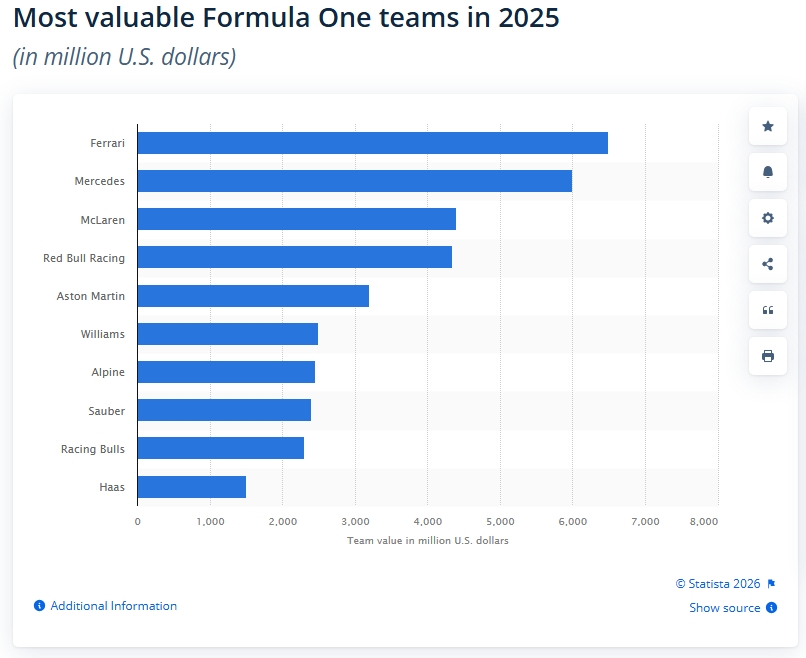
The Haas F1 team is now valued at over $1 billion. They’ve never won a race. They finished dead last in the constructors’ championship twice in the past four years. This makes zero sense until you understand what changed in 2021.
The floor that didn’t exist before
Before Liberty Media took over, F1 team valuations tracked performance. Finish near the front, sign bigger sponsorship deals. Consistently struggle and finish near the back, your team became a financial black hole.
The 2021 cost cap and revenue sharing agreements flipped that model.
Every team now has a **guaranteed income stream** and a **controlled cost base**. You know what comes in, you know what goes out, and the gap between those two numbers is predictable.
That predictability is what makes a team an investable asset. Not the trophy cabinet.
Ferrari proves the point backwards
Scuderia Ferrari is the most valuable team in F1. Their last constructors’ championship was in 2008 and their last drivers’ championship was in 2007.
Two decades of inconsistent results yet they’re still worth more than any other team.
Why? Because **brand equity operates independently from Sunday results** when the underlying business model is stable. Ferrari’s valuation is built on decades of mythology, global recognition, and what that name means culturally.
The sporting results are almost secondary at that point.
Luxury brands as proof of concept
When Alpine brings in Gucci as a partner, that’s not about selling more handbags to F1 fans. It’s a signal to the next investor that serious brands want to be here. And that signal de-risks the next conversation with a potential buyer.
You’re not pitching “we might win races someday.” You’re pitching “this is a stable platform with controlled costs, guaranteed revenue, and blue-chip brand validation.”
That’s a different conversation entirely.
The foundation matters more than the finish
Winning still helps. Performance still drives sponsor interest and fan engagement.
But the reason you can now value a last-place team at ten figures is because Liberty Media **strengthened and updated the foundation** to better suit international sport.
The cost cap created a ceiling. Revenue sharing created a floor.
Everything between those two lines became investable, regardless of where you finish on Sunday.
That’s the real story behind the billion-dollar valuations. Not the lap times.