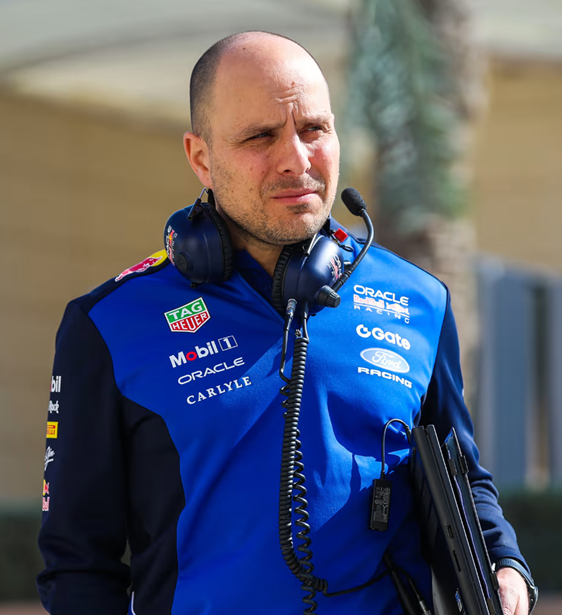
Gianpiero Lambiase is leaving Red Bull for McLaren in 2028. Most F1 fans will shrug at this news because they’ve never heard of him.
They know Max Verstappen. Four-time world champion. The face of Red Bull Racing. The guy who gets the podium, the trophy, the champagne.
But here’s what most people miss: Verstappen has had exactly one race engineer in his entire Red Bull career. That engineer is Lambiase. Nine years. Four championships. Zero other voices in his ear during a race.
After his first title in 2021, Verstappen told Ziggo Sport flat out that if GP stops, he stops too.
Now McLaren has poached him. And I think this signals something bigger than one engineer switching teams.
The Exception, Not the Rule
Personnel switching teams in F1 happens constantly, it always has. Engineers move, mechanics move, technical directors move; this dynamism keeps the sport healthy and competitive.
What’s exceptional is how long Red Bull kept their core team together.
Think about the dominant eras in F1 history. Ferrari during the Schumacher years. Mercedes at the outset of the turbo-hybrid era. Red Bull from 2021 to 2024. The common thread? Teams that keep their key people together build something lasting.
Red Bull managed this for nearly a decade, which is rare. That’s the exception to the rule.
But dynasties don’t last forever. People want new professional challenges. Race personnel can burn out from constant travel and long hours. They find working environments that suit them better. Some choose to remain in the sport for decades. Others move on after a few years.
It’s the nature of Formula One.
McLaren’s Calculated Raid
Lambiase isn’t the only figure from Red Bull to join McLaren recently. Rob Marshall became Technical Director in 2024. Will Courtenay started as Sporting Director at the beginning of 2026.
This isn’t opportunistic poaching. This is systematic talent acquisition.
Zach Brown and McLaren’s ownership group want to create a foundation where they can consistently compete at the front. That involves securing key people they believe will give them this opportunity. They think Lambiase is a good organizational fit who can maximize his value in his new role.
They must believe GP offers McLaren something lasting that could keep them at the front and make them an attractive place to work.
Here’s what I find interesting: Lambiase recently turned down an offer from Aston Martin to be their team principal. He chose to remain in engineering leadership rather than ascend to the traditional “top” of team management.
That tells you something about what he values. Technical influence over administrative power.
The Science vs. Art Question
Verstappen is a generational talent. Like Ayrton Senna he is a mercurial, raw talent that shows up maybe once every thirty years.
But even titanic talents like Verstappen need direction and guidance. He needed somebody like Lambiase to harness and mold that raw talent into results. They understood and trusted each other from their years together.
The results show this was an incredibly effective combination. They won races and championships, sometimes despite difficult cars and internal distractions.
Drivers like Senna, Schumacher, Hamilton, Alonso, Vettel, and Verstappen would be winners based upon their incredible talents. However, to get the most out of their skills, they needed guidance and good judgment.
In a high-stress, high-stakes environment like a grand prix race, that relationship and trust serves as a catalyst that accelerates and amplifies results.
Think about what happens when these partnerships break up.
Jeff Gordon and Ray Evernham at Hendrick Racing were dominant together. After Ray left, Gordon went from a dominant driver to a decent one. In IndyCar racing, the combination of Alex Zanardi and Mo Nunn was explosive for three years. After Zanardi came back from a disastrous season at Williams in F1 though, he wasn’t the same and never won another race.
Those are dramatic drop-offs in performance.
The Economics Don’t Make Sense
If engineers are this critical to performance, why do drivers make tens of millions while top race engineers make a fraction of that?
Part of it is commercial appeal. Drivers are used extensively for sponsor’s marketing efforts. In many cases, these companies have paid for most or all of a driver’s salary. Some of this is tied to specific markets like the UK, Latin America, Japan, or North America. Some ties to general commercial appeal for a given driver.
Engineers may be heard on team radio and seen on TV but they aren’t in the spotlight like the drivers are.
F1 is mostly driven by the popularity of drivers like Max Verstappen or Franco Colapinto or teams like Ferrari or McLaren rather than the technical brains behind them.
Here’s the uncomfortable reality: race engineers earn around $135,000 on average, with top individuals paid much more. Meanwhile, established race-winning drivers command multi-million dollar contracts. The highest can earn $54 million or more per year.
That’s a 400:1 ratio between top driver and average race engineer salaries.
There will be gaps in any system. Think of why Lance Stroll is still in F1. He has financial backing from his father, therefore he stays in the sport. It’s not rational but F1 runs on money so you could argue there’s an economic reason for this.
Talent matters but commercial reasons matter more than most people realize.
The Williams Blueprint
McLaren may be creating a structure where they focus on retaining a foundation of technical talent over the years and cycling drivers in and out of their team.
They’ll be in a better position to bargain with their drivers. They can point to the fact that a driver who signs with the team will have the best talent behind him, one that can win without a superstar drive.
Think of Williams in the nineties. They won four World Drivers’ Championships with four different drivers over the span of six years. Go further back and they won with Alan Jones, Keke Rosberg, and Nelson Piquet! Seven different drivers won championships with Williams over 17 years.
The team’s engineering foundation mattered more than individual driver talent.
McLaren may think their money is better spent on engineering rather than driver talent. Zach Brown has developed a talent pipeline and can assess which current drivers could slot in well with the team.
It’s a calculated approach but one that relies on breadth and depth of talent behind the scenes rather than just behind the wheel.
The 2030 Shift
The trend seems to be going towards more of an engineering-led focus where technical folks run the team and key players are sought after.
Top driving talent is expensive and can be difficult to manage. Think of Lewis Hamilton and Fernando Alonso for example. So it makes sense for teams to go with a more foundational approach. More science and less art.
There will be personalities in F1 as there has always been. That’s the nature of any sporting competition. Fans love the drama and excitement inherent in all forms of racing, and they often get it.
Where I see it moving is drivers may be in a weaker position to bargain based solely on talent. Teams will want drivers who fit into their system and culture, which means they’ll say no to a potentially more talented driver who brings a lot of potential problems.
Also, the drivers are earning a lot from their own ventures outside of racing. This may not be much of an issue. Lewis Hamilton will continue to make tens of millions a year even after he retires, such is his commercial draw.
So I think it will be a matter of what the teams pay rather than what a driver ultimately earns from racing.
What This Means for Red Bull
Lambiase adds to the long list of key contributors who have left Red Bull within the last two years.
Adrian Newey announced he would be leaving in early 2025. Having built a legendary career designing championship-winning cars for Williams and McLaren, Newey joined Red Bull in 2005 and became instrumental to its success. His designs underpinned Sebastian Vettel’s dominant run from 2010 to 2013, as well as Max Verstappen’s title-winning era between 2021 and 2024.
Team principal Christian Horner, sporting director Jonathan Wheatley, motorsport advisor Helmut Marko, and strategist Will Courtenay all departed.
When you remove the visionary, the regulator, and the tactician, you’re not just losing employees. You’re stripping away the institutional memory that won nearly one out of every three races the team ever entered.
This represents the fastest disintegration of a championship-winning technical team in modern F1 history.
For drivers in the Red Bull system trying to move up, it depends upon whose guy they were. Was a driver backed by Christian Horner, Helmut Marko, Laurent Mekies, Oliver Mitzlaff, Ford, or somebody else within the organization?
Whoever has the upper hand politically or commercially will drive that decision.
I think Liam Lawson may be in a difficult position long-term because his commercial appeal is less since he comes from a relatively small market in New Zealand and was brought up within the Red Bull Junior program, which Marko ran.
If he performs though, he could stay on a while like Tsunoda did.
The Uncomfortable Truth
F1 fans worship drivers as the stars of the show. We buy their merchandise. We follow their social media. We debate their greatness.
But the role of the race engineer is critical to the success of a team. That relationship and the culture it operates in is essential to producing consistent results.
I’m not saying we’ve been looking at the wrong people this whole time. Drivers matter. Their talent, their bravery, their ability to perform under pressure are all real.
But maybe we’ve been undervaluing the other half of the equation.
When McLaren starts publicly valuing their engineers the way they value drivers, it could influence the sport’s economics. They may be creating a structure where they focus on retaining a foundation of technical talent over the years.
That’s a different philosophy than most teams have followed.
And if it works, others will copy it.
By 2030, we might see teams actually structured around star engineers rather than star drivers. The trend is already moving that direction. Technical folks run the team and key players are sought after.
Whether that makes the sport better or worse depends on what you value. The drama and personalities will still be there. That’s the nature of competitive racing.
But the power dynamics are shifting.
And Gianpiero Lambiase’s move to McLaren might be the clearest signal yet that the shift is already happening.