When I first heard that both Toto Wolff and Christian Horner were eyeing a stake in Alpine, I knew this was bigger than just another F1 investment story.
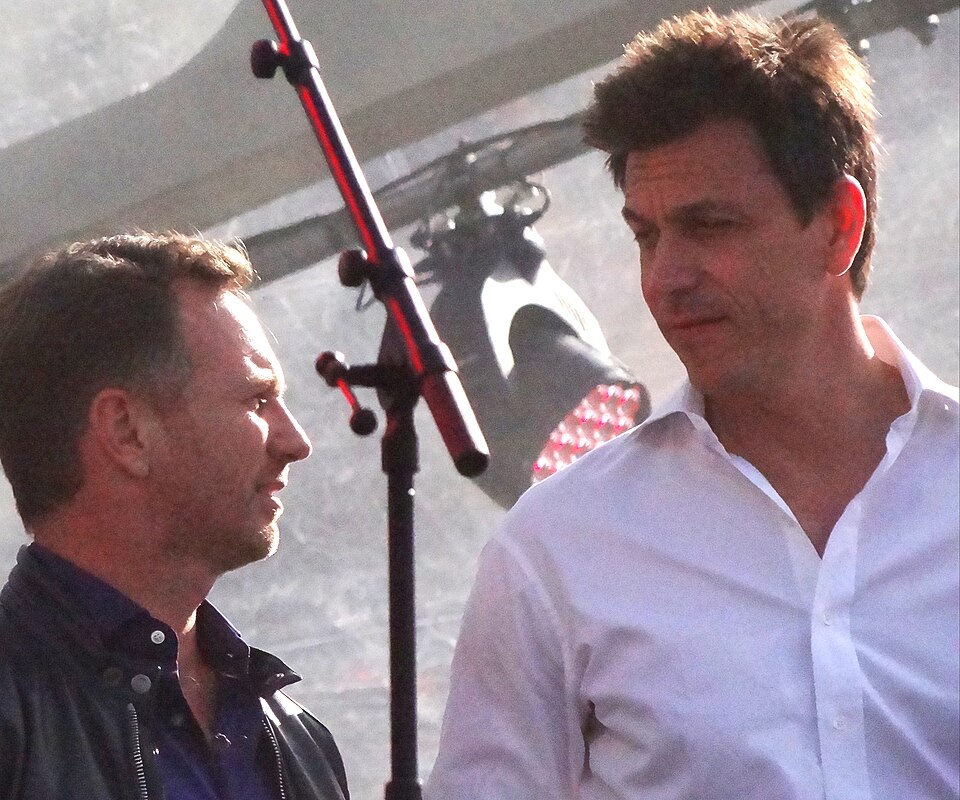
The rumors about Horner had been circulating for a while. His relationship with Flavio Briatore made it plausible. But when Wolff emerged as a surprise bidder just 18 hours before the Australian Grand Prix, the whole dynamic shifted.
This isn’t about two wealthy guys wanting to own more race cars.
This is a proxy war between two competing visions for Formula 1’s future, playing out through a £448 million bidding war for Team Enstone.
Horner’s Comeback Attempt After Red Bull
Here’s what most people don’t realize: Horner was fired from Red Bull in July 2025 after 20 years as team principal.
Red Bull CEO Oliver Mintzlaff said Horner’s methods were “trapped in the past.” That’s corporate speak for a fundamental disagreement about F1’s direction.
Horner’s on gardening leave right now, but he could return to the sport this summer. He’s publicly stated he’ll only come back “as a partner, rather than a hired hand.” He wants ownership, not just another team principal role.
I think Horner wants to prove something. His success at Red Bull, eight drivers’ championships and six constructors’ titles, needs to be validated as his achievement, not just because Dietrich Mateschitz loved racing and had hundreds of millions to spend.
Racing is an addiction. The speed, the money, the fame, the glory. Horner loves the spotlight and being involved with a team is part of his identity. He misses it.
Alpine makes strategic sense for him. The Enstone facility is in Oxfordshire, close to his home. Team Enstone has operated under multiple names; Benetton, Renault, and Lotus with a winning heritage that could be revitalized with better management and steady leadership.
Wolff’s Empire-Building Strategy
Wolff’s motivations are completely different.
He became a millionaire as a savvy tech investor and finance guy. He’s a racer, but not at Horner’s level. His skill is managing the relationship with Daimler-Benz and running the race team as a business.
Here’s the play: Wolff manages multiple drivers and has several in his junior program. If he obtains Alpine, he can place his promising drivers there to give them experience. From that team, they either move up to Mercedes or move on to other teams.
All the while, Wolff gets a cut of their earnings.
It’s a farm team model, except at the highest level of motorsport. And it raises serious questions about competitive balance.
If Wolff wins this bidding war, he’ll manage drivers across nearly a third of the F1 grid. He currently manages Mercedes drivers plus Esteban Ocon and Valtteri Bottas. Alpine’s current lineup includes Pierre Gasly and Franco Colapinto, both of whom could be replaced with Wolff-managed drivers.
That’s unprecedented concentration of power. You’re talking about one person controlling driver careers, contract negotiations, and potentially race strategy across multiple teams.
The Mercedes Power Unit Connection
There’s another layer here. Alpine became a Mercedes customer in 2026, purchasing power units and gearboxes in a deal running through 2030.
If Wolff acquires an equity stake, this relationship expands beyond the usual works-customer arrangement. Mercedes could share technical information and create synergies that raise competitive balance questions.
We’ve seen this movie before. When Racing Point essentially created a clone of a Mercedes car, people called it the “Pink Mercedes” and questioned the independence of F1 teams.
Old Guard vs. New Guard
This bidding war signals a wider proxy fight between friends of the old guard (Ecclestone, Briatore, Horner) and the new guard (Wolff, Domenicali, Carey).
The old guard wants F1 to revert to a simpler formula: less technology, smaller cars, normally aspirated engines, fewer races, less reliance on manufacturers.
The new guard wants to build brands: media savvy, entertainment focus, manufacturer reliance, high-tech/high-efficiency/high-cost engines.
It’s a conflict of visions about the fundamental nature of the sport. It’s also just big personalities with big egos attempting to control F1’s direction.
Wolff likes the turbo-hybrid formula because his employer and team have been wildly successful in it. He’s a multi-billionaire due to his wise investment in Mercedes ownership and his ability to secure backing from Daimler-Benz. He’s a tech bro who’s also adept at racing politics.
Horner is more of a pure racer who transitioned into management successfully. He demonstrated the managerial acumen to take an underperforming team and get them to winning, then dominating. His relationship with Bernie Ecclestone and friendship with Flavio Briatore gave him insights into how to politically maneuver within F1.
Why Alpine Matters
So why is Alpine the battleground for this fight?
There’s a 24% stake in the team potentially for sale. With Renault Group’s waning interest, there could be even more equity available soon.
Alpine is the current iteration of Team Enstone, which has operated under multiple names over the years. It has experienced upheaval and drama over the past decade but also has a winning heritage.
Alpine is a going concern. They have everything they need to compete except stable ownership and competent leadership.
The team finished bottom of the constructors’ championship in 2025, making it both a turnaround challenge and an opportunity. With the 2026 regulation changes, whoever wins this bidding war inherits a blank slate to rebuild a historically significant team.
The Independence Question
If Wolff leads Team Enstone, would it be little more than a Mercedes B-team or an independent entity?
If Horner runs the team, that wouldn’t be a question. A Horner-run team would be independent and not associated with a manufacturer initially. He could lead an effort to bring a new one on in time; a company like Hyundai could decide that entering F1 makes sense with Team Enstone.
I’d rather see Team Enstone be an independent team with its own unique identity. They have a heritage they can use that most fans will recognize from the past.
But if Wolff makes it a Mercedes B-team, you’d see a series of top young talent cycle through. It wouldn’t necessarily become a race-winning operation because that’s not why it exists. The chances of top talent passing through that team would be high though.
The B-Team Problem
Farm teams work in American sports because they’re in different, lower leagues. A farm team in F3 and F2 makes sense. After all, F1 teams already work with selected lower formulae teams to place their talent and give them race experience.
But having a B-team at the same level calls into question the independence of the operation.
The relationship between Red Bull Racing and Racing Bulls has been under scrutiny since Red Bull purchased Minardi almost 20 years ago. It’s a tricky subject because the core tenant of F1 is that each team builds their own car and races it against other teams.
When multiple teams are owned by the same company or individual, it questions the independence of the team.
McLaren CEO Zak Brown has been outspoken that Red Bull’s ownership of two teams “creates a conflict of interest, compromises sporting fairness, and offers unfair advantages in sharing technical information.”
The FIA is working on rule tweaks for 2026 aimed at segregating A/B-teams more. But no current regulations prohibit an entity from owning stakes in multiple teams.
What This Means for the 2026 Grid
If Wolff wins, he’ll likely place his drivers at the team. That could mean both Gasly and Colapinto leave. Almost a third of the grid would be managed by Toto Wolff.
If Horner prevails, he could keep Ocon and/or Colapinto and/or another young driver he believes in. It could shake up the grid and offer more opportunities for drivers.
The FIA and Liberty Media could block either acquisition. It could come down to who would be most beneficial to the sport. Either Wolff or Horner would bring money, competent management, and likely better results to Enstone in time.
FOM will keep a close eye on this, but they may not have a lot of say if the current owners want to sell their stake to a given ownership group.
Wolff’s Bigger Game
There have been rumors that Wolff ultimately seeks to take on a leadership role within FOM. He could possibly replace Stefano Domenicali in due course.
Wolff is a wily and political player. I wouldn’t doubt that running FOM is his ultimate goal.
This is probably why Horner opposes him so much. Horner doesn’t want Wolff running the sport.
If Wolff’s endgame is running FOM and he’s building this empire of driver management and team ownership as his path there, we’re watching someone systematically position themselves to control the sport from top to bottom.
That vision is fundamentally incompatible with what Horner and the old guard want F1 to be.
F1 as Investment Arena
Liberty Media bought F1 in 2017 for $8 billion. It’s now valued at an estimated $22 billion.
The 2021 introduction of a cost cap turned notoriously cash-burning entities into profitable ventures. 80% of teams were profitable in 2023.
This transformation has attracted an influx of private equity and celebrity investors. Otro Capital acquired its 24% stake in Alpine for €200 million in June 2023, with backing from Ryan Reynolds, Rory McIlroy, Anthony Joshua, Patrick Mahomes, and Travis Kelce.
That valuation now looks modest. Aston Martin recently valued at $3.3 billion. Racing Bulls reportedly turned down a $2.3 billion buyout offer.
F1 team ownership has become one of the hottest investment opportunities in sports. Across the current 11 teams on the grid, only 25-30% of ownership is from pure car brands. The sport has become highly financialized.
The Personal Rivalry
Wolff and Horner’s contentious relationship was captured by Netflix’s Drive to Survive.
After Horner’s firing, Wolff texted him: “I didn’t know what to say, because on one side you’ve been a real asshole, but on the other hand, the sport will miss you.”
Horner replied: “I’ve loved locking horns with you all these years. No one else even came close, as the statistics point out. PS: You need a haircut.”
This personal animosity now plays out in a bidding war that could reshape F1’s competitive situation.
F1 fans on social media have accused Wolff of “weapons-grade pettiness” and “the ultimate pettiness, to buy ‘another’ F1 team to keep the guy you hate out of it!”
The personal dimension of this battle between two of F1’s most prominent figures could become as compelling as the on-track racing itself.
What Happens Next
This bidding war will determine more than just who owns Alpine.
It will signal which vision for F1’s future has momentum. Will the sport continue its transformation into a high-tech, manufacturer-driven, entertainment-focused global brand? Or will there be a pullback toward simpler, more independent racing?
Will F1 governance allow unprecedented concentration of power in one person’s hands? Or will they draw lines about competitive balance and team independence?
From an American fan’s perspective, I want to see real competition. I want to see independent teams with their own identities fighting it out on track.
But I also recognize that F1 is a business. The sport’s financial transformation under Liberty Media has been remarkable. Teams are profitable. Valuations are soaring. New investors are flooding in.
The Alpine bidding war sits at the intersection of all these tensions. It’s about money and power and ego and competing visions for what F1 should be.
Whoever wins won’t just own a piece of Team Enstone.
They’ll own a piece of F1’s future direction.