Mercedes just confirmed George Russell and Kimi Antonelli for 2026, and I think they’re signaling something bigger than a driver lineup.
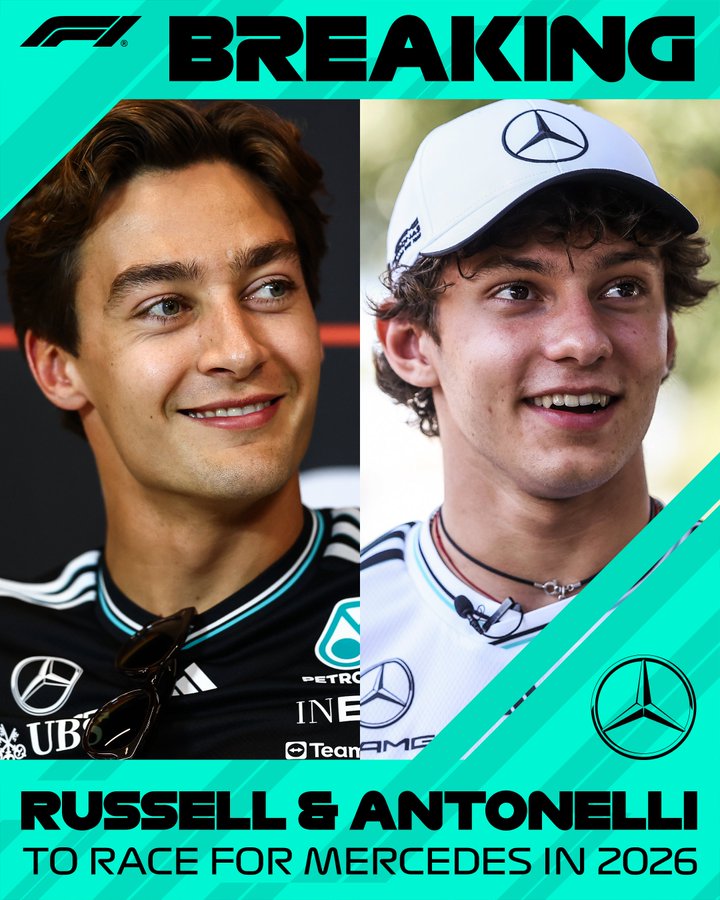
They’re killing the superstar era.
Look at what they didn’t do. They explored signing Max Verstappen over the summer. They could have chased another megastar to replace Lewis Hamilton. Instead, they doubled down on two drivers who came up through their own academy.
That’s not settling. That’s strategy.
The Harmony Tax
I keep coming back to one word: harmony. Mercedes learned this lesson the hard way with Hamilton and Rosberg.
That rivalry nearly destroyed the team. Toto Wolff actually threatened to suspend both drivers at the height of their conflict. He called the negativity “destructive” and said he’d never allow that energy in the debriefing room again.
Three on-track collisions. Psychological warfare. A formal “rules of engagement” document that still couldn’t prevent the Barcelona crash.
Yes, they won championships. But at what cost?
McLaren Is Proving The Point Right Now
Watch what’s happening at McLaren this season. They have a dominant car and two drivers capable of winning the title.
Max Verstappen still has a shot at the championship.
Why? Because McLaren’s equality is costing them. After the chaos at Monza, they had to implement team orders favoring Norris. The intra-team fighting literally gave away positions while Verstappen, the undisputed number one at Red Bull, kept grinding out results.
That’s the hidden cost of two equal superstars. You spend energy managing egos instead of winning races.
The Natural Hierarchy Solution
Here’s what Mercedes figured out: you can have a clear team leader without the politics that destroyed Hamilton-Rosberg.
Russell becomes the de facto number one based on performance, not team orders. He outscored Hamilton by 35 points in 2022 when the car was struggling. He got their only win that season in Brazil. He handled the pressure of being teammates with a seven-time champion without flinching.
Antonelli is talented but young. He’ll need several seasons to develop, just like Russell did at Williams. That creates a natural performance gap without requiring controversial orders or political maneuvering.
No drama. Just racing.
Graduation Day
Both Russell and Antonelli came up through Mercedes’ academy. They know the culture. They understand expectations. They’re not outsiders learning new team dynamics while cameras document every misstep.
Compare that to Ferrari bringing in Hamilton. New country, new language, new team structure. The weight of media attention, sponsor demands, and expectations follows him everywhere.
Mercedes is trading headline-grabbing star power for operational efficiency. And with 2026 regulations resetting everything, that might be the smarter play.
What This Means For F1
I think we’re watching a fundamental shift in how teams approach driver selection.
If Mercedes wins championships with this harmony-first approach while Ferrari struggles with their superstar pairing, other teams will take notice. They’ll start asking: is the biggest name worth the biggest drama?
Missing out on Verstappen early in his career stung Wolff badly enough that he built an entire academy system in response. Now Antonelli is the proof of concept. If this works, if he develops into a champion through Mercedes’ pipeline, it validates a completely different model.
Teams will look for drivers who fit their culture and values, not just the fastest name available. They’ll prioritize known quantities over unknown variables.
Because sometimes the biggest stars come with the biggest costs. And those costs aren’t always worth paying.