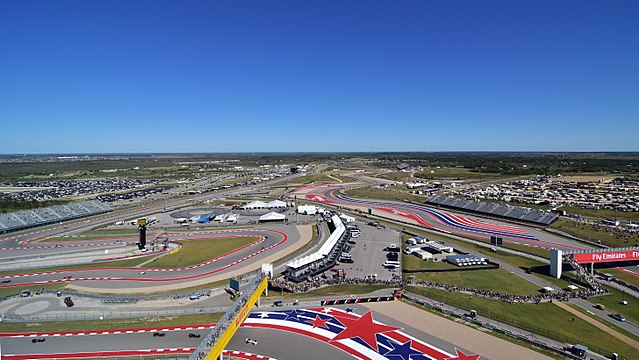
Formula 1 just extended its Circuit of the Americas contract through 2034. That’s an eight-year commitment to a venue that operates on fundamentally different economics than the sport’s other American races.
The numbers tell you why.
COTA drew 430,000 attendees in 2024. Miami pulled 275,000. Las Vegas attracted 306,000. Austin isn’t just winning the attendance battle, it’s dominating by nearly 60% over Miami and 40% over Vegas.
That gap reveals something about how F1 venues actually work in America.
The Muscle Memory Model
The grand prix can’t be a “build it and they will come” hope. It needs to be planned as an event and structured in a way that’s economically viable over decades, not just race weekends.
COTA figured this out early.
The circuit hosts more than one million visitors annually across MotoGP, NASCAR, concerts at their 14,000-capacity amphitheater, and dozens of smaller events. That year-round activation supports 9,100 jobs and generates over $10 billion in economic impact across Central Texas since 2012.
But the real value isn’t just revenue diversification.
Running all-size events throughout the year builds organizational capability. Staff and organizers develop the muscle memory needed to execute complex operations. They get feedback during smaller events and make adjustments before the big weekends arrive.
You can’t buy that kind of operational excellence. You have to build it through repetition.
Authentic Versus Flashy
Miami and Vegas are more flashy. Austin is more authentic.
COTA doesn’t have the same energy as a street circuit embedded in a major city. But it has the character of a traditional road course, similar to Silverstone, Monza, or the Red Bull Ring. That character and those wide open spaces fit the Texas motif perfectly.
The permanent facility matters beyond just track layout.
When you’re outside of town on purpose-built infrastructure, you’re making a statement about long-term commitment. You’re not renting city streets for a weekend. You’re investing in facilities that improve year after year.
F1 tried the American street circuit approach before. Long Beach and Detroit drew fans initially but faded over time. Phoenix never established itself at all.
Building a track like a traditional European road circuit was a statement of intent. Take the best elements of F1 and showcase them on a purpose-built facility in Texas. That strategy is paying off.
Three Races, Different Regions
The three-race American strategy works because each event draws from different catchment basins. The United States is massive, with distinct regions that have their own cultures and identities.
Austin brings Texas culture, a thriving music scene, and laid-back atmosphere. Miami delivers tropical glamour and international flair. Vegas offers pure spectacle and entertainment excess.
As long as they remain distinct events, three grand prix shouldn’t cannibalize each other.
The geographic separation helps. But the cultural differentiation matters more. You’re not just attending different races, you’re experiencing different versions of what an American F1 event can be.
The Cadillac Question
COTA is expanding its paddock and pit facilities to accommodate Cadillac when they join as F1’s eleventh team in 2026. That’s more than just adding garage space.
Cadillac wants to demonstrate they’re not just an American brand. They’re aiming to compete on the world stage against Ferrari and Mercedes. Meanwhile, F1 wants to embrace more American companies as it expands in the U.S. market.
The potential is massive for both parties.
F1 can succeed without Cadillac. But having them in the series draws more attention to the sport. Success in motorsport comes from ongoing commitment coupled with technical innovation. Cadillac has the backing of General Motors and the resources to succeed if properly led.
That “if properly led” qualifier matters. American manufacturers have struggled in F1 before. Ford made multiple attempts that didn’t pan out. The difference this time is the broader ecosystem that’s developed around F1 in America.
The Accessibility Paradox
Here’s the tension nobody wants to talk about.
Grand prix are already expensive events to attend. If ticket prices climb too high, younger fans get priced out. And racing is addictive specifically because of the visceral experience of attending a race.
The demographic shift makes this critical. 47% of new U.S. F1 fans who started following within the last five years are aged 18-24. Over half are female. These younger fans engage with F1 content daily through streaming and social media.
But social media engagement doesn’t pay for paddock expansions and infrastructure improvements.
COTA chairman Bobby Epstein believes Austin brings two key factors: pure racing and affordable tickets. That positioning matters when you’re competing against Miami and Vegas, where VIP experiences and celebrity sightings drive the value proposition.
The challenge is maintaining that accessibility while funding the operational excellence that makes the event work.
Looking Toward 2034
I can see three American races being possible through 2034. But two events feels more likely. Probably Miami and Austin on opposite ends of the calendar.
Other nations will want to host grands prix. The commercial interest is surging. Every F1 team is now worth more than $1 billion, and countries are queuing up for calendar slots.
Something has to give.
When that consolidation happens, the venues with sustainable economics and operational muscle memory will survive. The ones built purely on spectacle and short-term thinking won’t.
COTA just bet eight years that authenticity and operational excellence matter more than flash. Based on the attendance numbers and economic impact, that’s looking like a smart wager.
The real question is whether they can maintain ticket accessibility while continuing to invest in infrastructure. That balance will determine not just COTA’s future, but the entire model for how F1 works in America.