When you watch an F1 race, you see the obvious stuff; the overtakes, the podiums, the champagne.
Team leaders see something completely different.
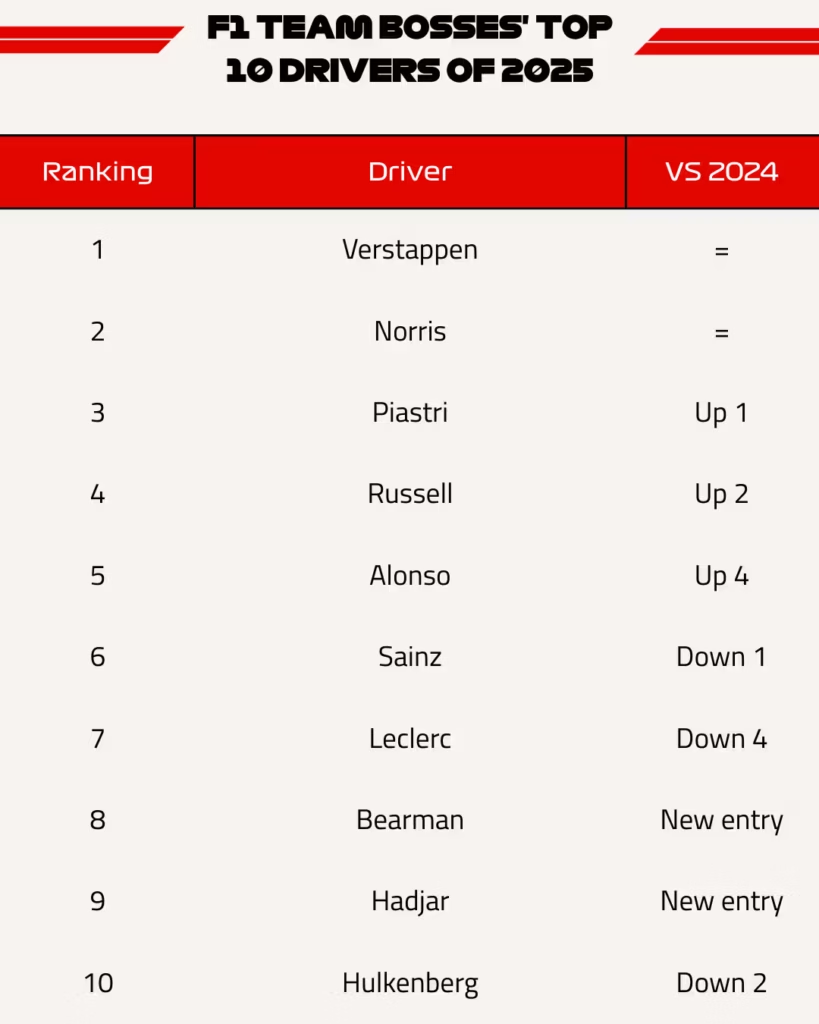
For the fifth consecutive year, F1’s team principals have submitted their secret ballots to rank the top 10 drivers on the grid. Max Verstappen topped the list again, but the real story isn’t who won. It’s what this ranking system reveals about how the sport’s most powerful decision-makers actually evaluate talent.
The gap between what fans see and what team leaders measure is massive. And understanding that gap changes everything about how you watch F1.
The Invisible Performance Metrics
Fans don’t see tire management. They don’t track consistency lap-by-lap. They miss the mental strength required to perform when circumstances turn ugly.
Team leaders track all of it.
Take Charles Leclerc’s Monza victory in 2024. The race looked straightforward on TV; Ferrari beats McLaren at home. But the data tells a different story. Leclerc maintained an average pace of 1:23.5 throughout his second stint, even in the final laps, despite being up to 1.5 seconds slower than Piastri at times.
That’s not just speed. That’s precision.
He managed graining masterfully, executed strategy flawlessly, and delivered consistency despite changing fuel loads and tire wear. Ferrari’s team principal noted that tire management, once their biggest weakness, had become one of their advantages.
This is the kind of performance that separates good drivers from championship material in the eyes of team leaders. It’s a mesmerizing feat of consistency coupled with relentlessness that most fans completely miss.
The Financial Reality Behind Every Lap
Here’s something American fans need to understand: every position matters financially.
Finishing ninth versus fifth in the constructors’ championship means a $20 million difference in prize money. That’s why teams need drivers who perform at a high level whether they’re leading by 30 seconds or struggling at the back.
You can’t just give up and quit. Millions of dollars hang in the balance. Media exposure for sponsors depends on it. Teams evaluate drivers on their ability to maximize results in every single session, every single lap, across an entire season.
This is why overperforming in subpar equipment gets noticed immediately. Team principals know exactly how much difference a driver can make with the equipment at their disposal. Even when race results don’t show it, the decision-makers in the paddock and along the pit wall see it clearly.
The Teammate Comparison Advantage
Performance against your teammate removes the car from the equation.
The driver alongside you in the garage has identical equipment. If that driver performs at a known level, you can measure the other driver against them with precision. When a team with an inferior car qualifies or races to an unexpected position, team leaders take note.
Charles Leclerc at Sauber demonstrated this perfectly, especially during qualifying. He extracted performance from that car that shouldn’t have been possible.
This teammate comparison acts as the ultimate control variable. It’s one reason why the annual ranking system works; many team principals have run or worked for multiple teams throughout their careers. They bring breadth of experience that comes with time in the sport. They observe how drivers handle pressure, judge conditions, and weigh risk versus reward across different machinery and circumstances.
The Cognitive Skills Revolution
Carlos Sainz wasn’t afraid to challenge Ferrari when he thought a call needed to be made.
That matters more than you think.
Sainz has the capacity to think through variables like weather, track position, and strategy while racing at 200 mph. He makes better calls because he understands where he sits in a given race. It’s like having a second strategist in the car.
This cognitive ability is exactly why Williams wanted him. When Sainz signed with Williams, he predicted fifth position for the team and a couple of podiums. Those results materialized, providing vindication for his choice. He described helping Williams’ quest back to the front as his “life project.”
Teams want performance, but they also want harmony.
Sainz and Alex Albon at Williams exemplify this perfectly. Both are fast, but they’re also apolitical and team-oriented. They maximize results through this approach. The team values this attribute enormously. Both drivers are humble enough to work together, push each other, and drive the entire team to do their absolute best.
You can only discern this characteristic through interaction and working closely with a driver. It doesn’t show up in lap times or qualifying positions.
Why Consensus Beats Individual Opinion
The ranking methodology matters. Team bosses submit their top 10 lists under the condition their personal rankings remain secret. Scores follow the current points system (25 points for first down to one for 10th) then combine to create the final ranking.
This secret ballot approach mitigates individual biases.
Ten team principals participate: Alessandro Alunni Bravi, Christian Horner, Ayao Komatsu, Mike Krack, Laurent Mekies, Oli Oakes, Andrea Stella, Fred Vasseur, James Vowles, and Toto Wolff. Each brings different perspectives, different team structures, different priorities.
Red Bull focuses primarily on Max Verstappen. McLaren balances between Oscar Piastri and Lando Norris. Both approaches work, but they require astute management and effective communication. The composition of the team and how everybody works together determines success.
All drivers bring combinations of strengths and weaknesses. Figuring out how best to apply those attributes is the challenge. This is why aggregating multiple team perspectives creates fairer, more accurate rankings than relying on any single expert’s opinion.
The Alonso Paradox
Fernando Alonso ranks higher in team principal evaluations than pure talent might suggest.
His outright speed may be fading in his forties, but his desire and drive compensate. Team principals recognized him for his ability to extract results beyond the limits of his machinery, placing him four positions above the 2024 rankings despite not having his strongest statistical season.
Alonso has desire and drive coupled with a ferociously competitive spirit.
His grit, determination, and consistency were evident from an early age. He hasn’t lost that. Team leaders still value artistry under pressure, the intangibles that separate drivers into various tiers.
This is what American fans need to understand: it’s how drivers work with the team before and during the race. It’s consistency and performance throughout an entire race distance. It’s the ability to perform at peak level even when circumstances aren’t going their way.
It’s really about maximizing results and consistently delivering over the course of a long season.
F1’s Moneyball Era
The sport is approaching a data revolution similar to baseball’s Moneyball transformation.
Teams will examine various quantitative and qualitative attributes for drivers, then decide which drivers fit based on goals and budget. Performance and personality both matter because F1 is intensely team-oriented. Drivers are important parts of the performance equation, but everybody has to work together to maximize results.
The five-year consistency of this ranking tradition tells us something important about F1’s future. When Verstappen and Leclerc consistently appear in top positions, it provides an honest assessment of their relative talent. When drivers consistently appear in the top ten at roughly the same ranking year after year, team leaders are telling us something definitive about their capabilities.
This consensus-driven evaluation represents a shift toward comprehensive performance frameworks. It’s pushing F1 to value cognitive skills, team harmony, and consistency alongside traditional metrics like raw speed.
For American fans trying to understand who truly deserves their spot on the grid, the lesson is clear: look beyond Sunday’s results. Watch how drivers work with their teams. Notice consistency across an entire season. Pay attention to performance when circumstances turn difficult.
That’s what team leaders see. And now you can see it too.