When Jack Doohan signed with Haas as a reserve driver for 2026, I’ll admit I was surprised. Not shocked, but genuinely curious about what this move meant beyond the headline.
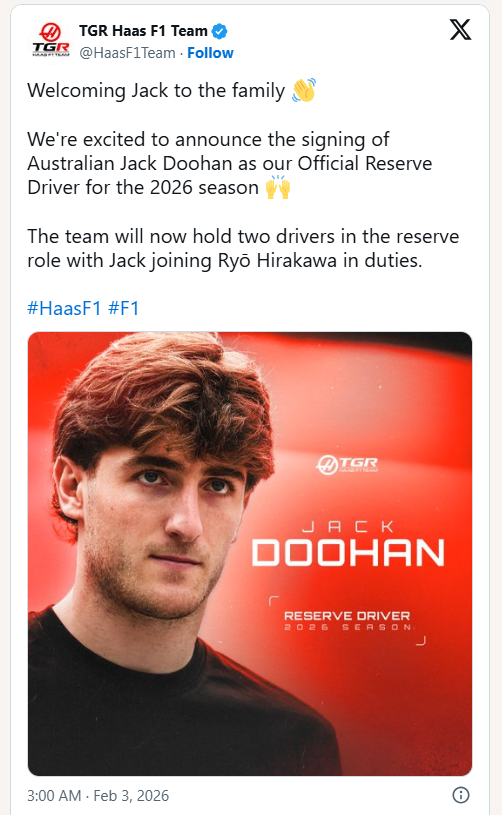
Here’s a driver who got seven races with Alpine, failed to score a point, got replaced by Franco Colapinto, watched his Super Formula opportunity collapse after crashing three times at Suzuka’s Degner 2 corner, and somehow landed back in F1. That’s not the typical trajectory for a displaced driver.
But the more I looked into this signing, the more I realized Doohan’s story isn’t really about Doohan at all.
It’s about Haas becoming something it’s never been before.
The Reserve Role Just Got a Lot More Valuable
Reserve drivers used to be insurance policies. You kept them around in case someone got hurt or sick. They’d show up to a few races, sit in the garage, maybe do some simulator work, and collect a paycheck.
The 2026 regulations changed that calculation completely.
Teams are facing what McLaren describes as “arguably more ambitious” regulatory changes than F1 has ever attempted. New tires, new fuel, new engine, new chassis, new sporting regulations. Everything starts from scratch.
When you’re managing energy recovery systems that can harvest 9MJ around parts of the lap, and drivers need to strategically deploy 4MJ in 11.5-second bursts, you need someone grinding through simulator sessions and test days to figure out what actually works.
That’s where Doohan comes in.
Haas team principal Ayao Komatsu has an engineering background. He’s mapping out multiple development programs that need evaluation before the team commits resources to any single direction. Having Doohan available to run extensive testing through Haas’s TPC (Testing of Previous Cars) program means Esteban Ocon and Oliver Bearman can focus on race weekends while Doohan handles the data-gathering operation.
It’s not glamorous work. But it’s invaluable when everyone’s starting from zero.
What Actually Happened at Alpine
Let’s talk about those seven races with Alpine, because the narrative and the reality don’t quite match up.
Yes, Doohan failed to score a single point. But Franco Colapinto didn’t score for Alpine either across the remaining 18 rounds, despite Flavio Briatore’s commercial calculations about his marketability.
I think Briatore wanted Colapinto for his fanbase and backing. Doohan has a famous last name, but he doesn’t have the social media following or sponsor appeal that Franco brings. Briatore saw more commercial potential in Colapinto and made the swap.
Doohan was a placeholder from day one.
The car was the problem, not necessarily the driver. Sky Sports noted the speculation about Doohan’s replacement started “before the first race of the 2025 season,” which tells you everything about how Alpine viewed his tenure. When Pierre Gasly outperformed both rookies, it was mostly due to experience, not because the car suddenly became competitive.
A half-season would have been a fairer assessment period. But other considerations took precedence.
The Super Formula Door That Closed
After Alpine, Doohan tried to land a seat in Japan’s Super Formula series. That deal fell apart due to disagreements with Kondo Racing over engineering setups and car competitiveness.
This reveals something most fans don’t realize about the modern driver market.
There aren’t many places left to go.
F1 used to have larger grids with more driver turnover. IndyCar was a viable landing spot for displaced F1 drivers. Both series have fewer available seats now. Super Formula isn’t as open as people think. WEC is growing but most teams have their lineups set. Formula E has openings but isn’t seen as a top-tier championship.
Racing is safer and more sustainable than it used to be, which means fewer opportunities for younger, less experienced drivers. The market contracted while the talent pool expanded.
For someone like Doohan, staying visible in the F1 paddock, even without a race seat, becomes more valuable than competing in a secondary series. You need to be where the decision-makers are.
Why Haas Actually Wanted Him
Haas isn’t looking at Doohan’s Alpine results and seeing a future race winner. They’re evaluating something else entirely.
Komatsu specifically highlighted “the dedication required to remain sharp and prepared to race while getting to know how the team works” as a key qualification. He praised Doohan’s experience in the reserve role itself, not his qualifying pace or race craft.
Mental toughness matters more than raw speed right now.
Doohan is known, like his father Mick, for being no-nonsense and tough. Haas values that work ethic because they need someone who can quietly contribute to team improvement through extensive testing and data collection. Someone who won’t complain about grinding through simulator sessions or running previous-generation cars at test tracks.
The Toyota partnership makes this possible. Haas now has resources to run 14 days of TPC testing in 2025, giving drivers like Doohan and Ryo Hirakawa invaluable seat time. They’re also installing their first-ever personal simulator at their UK base in Banbury, expected to be operational by May or June 2026.
This infrastructure fundamentally changes what being a Haas reserve driver means compared to other midfield teams.
The Bigger Story Nobody’s Talking About
When you step back and look at this whole situation, Doohan’s signing reveals something significant about where Haas is heading.
They’re becoming a real team.
Not a Ferrari B-team. Not a budget operation barely hanging on. A legitimate constructor with resources, infrastructure, and long-term vision.
Haas can now afford to run comprehensive reserve driver programs because the cost cap increased from $135 million to $215 million for 2026, and driver salaries remain outside that cap. They have money to invest in testing, simulator development, and commercial opportunities like running Hirakawa at Fuji Raceway to build goodwill with sponsors and partners.
Ayao Komatsu and the rest of Haas’s leadership realize the importance of building a team that can collect data, develop intelligently, and execute well. That means bringing in people who will roll up their sleeves and work hard, even when nobody’s watching.
A few years ago, Haas would have overlooked someone like Doohan. Now they’re actively seeking him out.
What This Means for American Fans
Watching Doohan get this second chance while Logan Sargeant is completely out of F1 stings a bit from an American perspective.
The contrast is stark. Doohan has a five-time motorcycle world champion as a father who knows how to work the political and commercial aspects of global motorsport. That support system matters as much as talent.
Logan didn’t have that guidance. He was pushed too hard, too fast, which led to accidents and ultimately his exit. A tough, experienced mentor might have helped him survive that fraught year and a half.
The lesson here isn’t about fairness. It’s about staying in the system.
Doohan probably hit his ceiling as an F1 race driver. He was decent in the lower formulas but not a phenomenon like Charles Leclerc, Oscar Piastri, or Lewis Hamilton. His path forward likely mirrors Mick Schumacher’s, who parlayed F1 experience into seats in WEC and now IndyCar.
But by staying visible in the paddock as a Haas reserve, Doohan keeps his options open. He’s positioning himself for what comes next rather than chasing a comeback that probably isn’t realistic.
That’s smart career management in a market where opportunities keep shrinking.
The Real Value of Second Chances
When the 2026 season starts in Melbourne on March 8, Doohan will be there as a reserve at his home race. Most people will see that as a consolation prize.
I see it differently.
He’s embedded in a team that’s growing stronger and more competitive. He’s contributing to a technical operation that could pay dividends when the new regulations shake up the grid. He’s building a reputation as someone who delivers results behind the scenes.
That reputation becomes currency in motorsport.
If Doohan can show Toyota Gazoo Racing that he brings value to Haas and helps them improve, other teams will hear about it. Opportunities follow performance, even when that performance happens away from the cameras.
The 2026 regulations represent the cleanest sheet of paper F1 has ever had. Teams are running millions of simulations to figure out energy deployment strategies and development directions. Being part of that process, even as a reserve, puts you in position to capitalize when things shift.
Doohan’s second chance isn’t really about getting back on the grid. It’s about staying relevant long enough to see what opportunities emerge from the chaos of a regulation reset.
And honestly, that might be the smartest play available to him right now.