When I first heard Adrian Newey would become Aston Martin’s team principal in 2026, my gut reaction was simple: this doesn’t make sense.
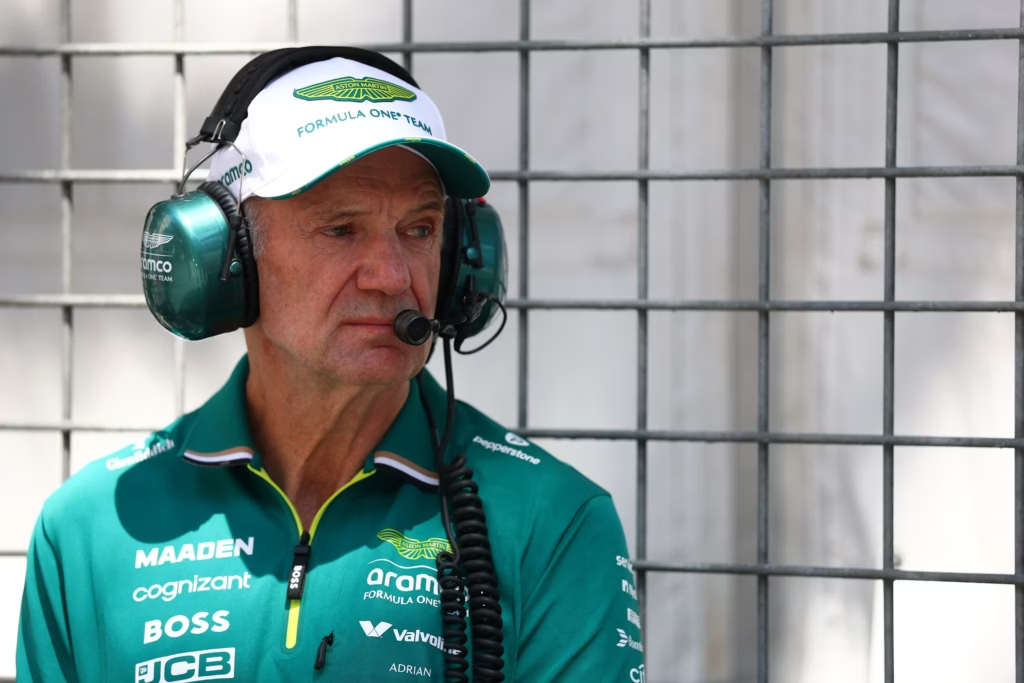
Here’s a design genius who left Red Bull partly because of political distractions, now stepping into arguably the most political role in Formula 1. The man who sketches championship-winning cars by hand is about to spend his days managing media obligations, FIA negotiations, and team principal squabbles.
But the more I’ve thought about it, the more I realize this isn’t just a career move. It’s a calculated short-term gambit that could fundamentally reshape how F1 teams operate.
The Engineer-Led Revolution Is Already Here
Newey isn’t walking into uncharted territory. F1 is already experiencing a quiet revolution in team leadership.
James Vowles took over Williams in 2023 after 20 years at Mercedes, where he played a key role in nine Constructors’ Championships. His engineering background immediately showed results. Williams finished seventh in the Constructors’ Championship and secured their first podium since 2021 at the 2024 Azerbaijan Grand Prix.
What did Vowles find when he arrived? Organizational chaos that mirrors what Newey faces at Aston Martin.
“There wasn’t even data on how much a component cost, or on how long it took to make the components,” Vowles revealed. His solution was brutally honest: stress the system to understand where it breaks, then rebuild it properly.
Haas is seeing similar benefits under Ayao Komatsu’s engineer-led approach. Meanwhile, Alpine remains mired in political battles, struggling precisely because they lack this technical leadership focus.
The pattern is clear. Teams led by engineers who understand the technical fundamentals are outperforming those with traditional commercial or sporting directors.
Why Newey’s Approach Will Be Different
Newey brings something Vowles and Komatsu don’t: a genius-level ability to design championship-winning cars coupled with 12 constructors’ titles and 14 drivers’ championships on his resume.
His move to Aston Martin represents the first time he’ll have complete control over both technical direction and team operations. He’s not just joining as managing technical partner. He’s assuming dual roles that give him unprecedented influence.
Fernando Alonso gets it. “With Adrian there is only one style, which is performance,” he said. “There is just the unlimited search for performance and perfection.”
But here’s what makes this fascinating: Newey isn’t planning to do this forever.
At 66, after decades on the IndyCar and F1 grids since the mid-eighties, he’s looking at this as a short-term leadership play. He’ll lead from the front for a season or two, establish his culture, get his people in place, then step back to guide the factory side of operations.
His mark will be permanent on both the technical and operational sides of Aston Martin.
The Newey Culture: Data Meets Analog Thinking
What does a “Newey culture” actually look like?
He’ll demand technical and operational excellence. That’s table stakes given his track record. But Newey brings something increasingly rare in modern F1: an old-school approach that balances cutting-edge data analytics with analog thinking.
He won’t abandon simulations, CFD, or other data tools. But he’ll expect keen observations and cognitive processing that only experienced humans can provide. His fundamental understanding of aerodynamics and vehicle dynamics goes back to his Leyton House designs in 1990.
This matters because most teams are going all-in on simulation and data analytics. Newey’s approach creates space for racing experience and intuitive engineering judgment to drive decisions alongside the numbers.
The Honda partnership amplifies this advantage. “Aston Martin’s team is engineering-led, and Honda are engineering-led as well,” team sources note. “As soon as you get into the engineering things, we talk the same language. The culture is the same.”
Honda’s “aggressive approach” and commitment to collaboration mirrors their successful Red Bull partnership. Newey knows Honda well, understands them, respects them. That engineering-first alignment will accelerate development cycles.
The Organizational Challenge Nobody Talks About
Aston Martin has the facilities. They have partners in Aramco and Honda committed to maximizing power unit performance. Lawrence Stroll has invested heavily in a state-of-the-art factory and wind tunnel at Silverstone.
The pieces are in place. What’s been missing is the organizational structure to maximize these assets.
The team’s biggest weakness is inconsistent decision-making at both the track and factory. Their upgrades are hit or miss. Their race strategy sometimes falters at critical moments.
These aren’t just execution problems. They’re symptoms of deeper organizational dysfunction.
When Newey walks in, he’ll examine the team’s structure and how it operates. Effective communication and rapid feedback loops will be essential, just as they were at Red Bull. If he can get Aston Martin to relay data and decisions correctly and accurately, the team will improve consistently.
Red Bull’s in-season development practices became the gold standard under Newey’s technical leadership. Their ability to iterate and improve throughout a season forced every major team to establish or expand junior programs, lower the average age of driver signings, and fundamentally rethink their operational models.
Aston Martin has the financial backing and facilities to replicate this approach. They just need the organizational architecture.
The Realistic Timeline for Success
I don’t think Aston Martin wins a race until 2027 at the earliest.
2026 will be a learning year. It’s the first year of the Honda partnership, Newey’s first year leading the team, and the first year of new regulations. That’s too many variables converging simultaneously for immediate success.
But after a few months of learning together, the team and its leadership will understand how effectively they’re executing their plans. They can identify what remains to be done and what pieces they need to win.
New drivers, a stable technical team, and operational excellence at races will bring wins and genuine competitiveness.
Championship challenges? That’s a 2028 conversation at the earliest, assuming everything goes right.
The Driver Dilemma That Could Undermine Everything
Here’s the uncomfortable truth: Lance Stroll needs to go.
He’s limited and not a race-winning talent. Fernando Alonso remains a generational talent, but he’s aging. Aston Martin is already looking at Jak Crawford to fill the younger driver role, and they’ll target one of the sport’s elite drivers to lead the team.
Max Verstappen and Charles Leclerc are at the top of that list.
But can Lawrence Stroll actually replace his son, even if Newey pushes for it?
I think Newey will have Honda and Aramco backing him up on this decision. If Stroll wants to win championships, it will have to be with somebody other than Lance behind the wheel. My guess is Lance moves to hypercar or another series if he still wants to race.
If Lance stays despite being the weakest link, that becomes the one compromise that undermines everything else Newey is building.
You can’t demand performance excellence everywhere except the cockpit. That sends the wrong message to the entire organization.
What This Means for F1’s Competitive Future
Newey’s move to Aston Martin signals more than one team’s ambitions. It represents a fundamental shift in how F1 teams define championship-caliber leadership.
The traditional model of commercial or sporting directors running teams is giving way to engineer-led organizations that prioritize technical excellence and operational efficiency. Williams, Haas, and now Aston Martin are proving this approach works.
If Newey succeeds in transforming Aston Martin into a genuine championship contender by 2027 or 2028, it will force every midfield team to rethink their leadership structures. Alpine’s political dysfunction will become increasingly untenable. Teams without technical visionaries at the helm will struggle to compete.
The talent acquisition arms race will intensify. Midfield teams will seek their own engineering geniuses who can replicate what Newey, Vowles, and Komatsu are accomplishing.
For American fans watching F1’s growth, this represents something significant. We’re witnessing the sport’s power structure potentially transform in real time. The old guard of traditional team management is giving way to a new model where engineering excellence drives organizational success.
Aston Martin has the money, facilities, and partnerships to compete at the front. With Newey providing the organizational architecture and technical leadership, they’re out of excuses.
Honda and Aramco expect championships. Lawrence Stroll has dedicated years to improving the team.
It’s time to step up.
The 2026 season will reveal whether Newey’s gambit pays off or whether the political demands of team leadership overwhelm even a design genius. Either way, F1’s leadership landscape is changing, and we’re all watching it happen.